Bronze Medallion (15 hr.): challenges the candidate both mentally and physically. Judgment, knowledge, skill, and fitness – the four components of water rescue – form the basis of Bronze Medallion training. Candidates acquire the assessment and problem-solving skills needed to make good decisions in, on, and around the water. Bronze Medallion is a prerequisite for assistant lifeguard training in Bronze Cross.
Prerequisite: Minimum 13 years of age or Bronze Star certification (need not be current).
Bronze Medallion Exam Policy: Defines the minimum conditions under which Bronze level examinations may occur. Read the current version of the Bronze Medallion Exam Policy in the Policies section of our website. This page also outlines the equipment both mandatory and optional needed and provides descriptions (Note that candidates are not responsible for obtaining this equipment).
:::
Instruction & certification: Current Lifesaving Instructors teach and evaluate most items, but only Bronze Examiners may certify candidates. The Lifesaving Society deems its certifications to be "current" for 24 months from the certification date.
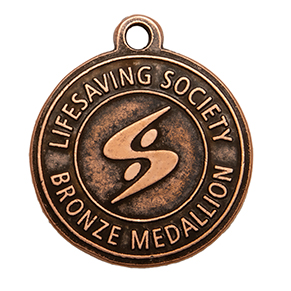
Candidate recognition: Bronze Medallion medal, Bronze Medallion Award crest, certification card.
Required reference material: Canadian Lifesaving Manual. Bronze Medallion Workbook recommended. (Note that some affiliates provide materials to candidates, and some require candidates to purchase materials on their own. Double check before you purchase.)
See a full list of optional and mandatory equipment needed for this course here. (Note that candidates are not responsible for obtaining this equipment).
At-A-glance
Knowledge Items
- *The Lifesaving Society: Demonstrate knowledge of the Lifesaving Society and awareness of its training program opportunities.
- *Drowning Chain of Survival: Demonstrate knowledge of the Drowning Chain of Survival.
- *Rescue process: Demonstrate knowledge of the Ladder Approach and the Rescuer’s Checklist and how the rescuer uses them in decision-making.
- *Cold water: Demonstrate knowledge of the dangers of cold water immersion and risk to the rescuer in cold water rescues.
Skill Items
- *†Self-rescue:
- Wearing a long-sleeve shirt and long pants, demonstrate (safely) a disorienting entry and swim 15 m. Remove and inflate pants and form a huddle for 1 minute with two or more others.
- Wearing clothing, simulate self-rescue techniques for cold water and moving water.
- *Swimming and lifesaving strokes:
- Swim 25 m or yd. each of: front crawl, back crawl, breaststroke.
- Swim 25 m or yd. each of: head-up front crawl, head-up breaststroke.
- Swim 25 m or yd. each of: whip kick, eggbeater, scissor kick or inverted scissor kick.
- *Victim recognition:
- In the water, simulate the appearance of a weak swimmer, a non-swimmer, an unconscious victim, and an injured victim.
- Recognize the difference between a weak swimmer and a non-swimmer; and recognize an unconscious victim and an injured victim.
- *Entries and removals:
- Demonstrate three entries with aids and three entries without aids.
- With the assistance of an untrained bystander, demonstrate the removal of a conscious and an unconscious victim.
- *†Defences and releases:
- In ready position, demonstrate ability to scull forward, backward and sideways for 60 seconds.
- Demonstrate three defences from the front, side, and rear and three releases from the front, side, and rear. Assume a ready position and communicate verbally after each defence and release.
- :::
- *Tows and carries:
- Demonstrate the use of three towing aids: tow a passive victim 15 m with each aid.
- Demonstrate three assistive carries and three control carries: carry a passive victim 15 m with each carry.
- *Search: Demonstrate an effective shallow water search.
- *†Submerged victim recovery: Demonstrate recovery of an unconscious victim from deep water: surface and carry victim to a point of safety 5 m distant.
- *Drowning resuscitation: On a manikin, demonstrate single-rescuer adult, child, and infant drowning resuscitation including ability to deal with complications.
Fitness Items
- *Rescue drill: Enter the water and swim head-up 25 m or yd. to contact a passive victim or manikin located at the surface and carry 25 m or yd.
- *†Endurance challenge: Swim 400 m within 12 minutes (400 yd. within 11 minutes).
Judgment Items
- *Risk assessment and response: While modelling safe personal behaviour, conduct a safety assessment of an aquatic environment and its activities. Identify and remove hazards where applicable and intervene in unsafe activities where appropriate.
- †Rescue 1 – from land: Perform a low-risk, non-contact rescue from land of a weak or tired swimmer located no more than 10 m away.
- †Rescue 2 – open water: Perform a non-contact rescue of a tired or weak swimmer or non-swimmer in open water with a towing aid or craft. Approach 20 m or yd. and tow 20 m or yd. to safety. Rescuer performs appropriate follow-up procedures including treatment for shock.
- †Rescue 3 – non-breathing victim: Perform a rescue of a non-breathing victim located at the surface in deep water, 5 m from point of safety. Remove victim and perform CPR on a manikin.
Note
- *Asterisk indicates instructor-evaluated item. The † symbol denotes the only items evaluated during a recertification.