Bronze Star (10 hr.): develops swimming proficiency, lifesaving skill and personal fitness. Candidates refine their stroke mechanics, acquire self-rescue skills, and apply fitness principles in training workouts. Bronze Star is excellent preparation for success in Bronze Medallion and provides a fun introduction to lifesaving sport.
Prerequisite: None (Swim Patrol experience recommended.)
Bronze Star Exam Policy: Defines the minimum conditions under which Bronze level examinations may occur.
Bronze Star requires a body of water that is at least 15 m long, 5 m wide and a minimum of 1.5 m deep (3 m preferred).
For all Bronze exams, the minimum number of candidates is one. Additional volunteers may be required to conduct an exam; however, the volunteers may not be the Examiner conducting the exam.
For Bronze Star, additional volunteers must participate as victims.
See a full list of optional and mandatory equipment needed for this course here. (Note that candidates are not responsible for obtaining this equipment).
:::
Instruction & certification: Current Lifesaving Instructors teach and certify candidates. The Lifesaving Society deems its certifications to be "current" for 24 months from the certification date.
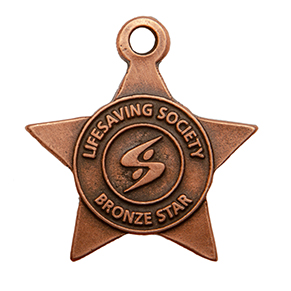
Candidate recognition: Bronze Star medal, Bronze Star Award crest, certification card.
At-a-glance
Knowledge Items
- The Lifesaving Society: Demonstrate knowledge of the Lifesaving Society and awareness of its training program opportunities.
Skill Items
- Self-rescue:
- Simulate self-rescue techniques for the following circumstances: ice, swamped or capsized boat.
- Wearing a shirt and lightweight pants, enter the water and don a lifejacket or PFD. Demonstrate HELP for 1 minute; form a huddle with two or more others for another minute.
- Entries: Demonstrate three safe entries appropriate to the environment.
- Swimming and lifesaving strokes:
- Swim 25 m or yd. each of: front crawl, back crawl, breaststroke.
- Swim 25 m or yd. each of: head-up front crawl, head-up breaststroke.
- Swim 25 m or yd. each of: whip kick, eggbeater, scissor kick or inverted scissor kick.
- Sculling: In ready position:
- Scull in place for 30 seconds.
- Scull head-first 10 m and scull
feet-first 10 m.
- Victim recognition: Demonstrate ability to recognize the difference between a weak swimmer and a non-swimmer.
- Reaching and throwing assists:
- Demonstrate two reaching assists.
- Demonstrate accuracy in throwing assists: throw a buoyant aid a distance of 5 m placing the aid within 1 m of the centre of a target three out of four times.
- Throw a buoyant aid with line to a victim
5 m distant and pull the victim to safety.
- Drowning resuscitation: On a manikin, demonstrate single-rescuer adult and child drowning resuscitation including ability to deal with complications.
- :::
Fitness Items
- Obstacle swim: On the instructor’s signal, swim 50 m or yd. submerging under an obstacle twice during the swim.
- Rescue drill: On the instructor’s signal, don a shoulder loop and line, enter the water and swim head-up to a partner or manikin located at the surface 25 m or yd. away. Tow partner or manikin to starting position.
- Fitness challenge: Complete a 400 m or yd. fitness training workout:
- 100 m or yd. warm-up.
- 6 x 25 m or yd. one of front crawl, back crawl, breaststroke, or lifesaving kick.
- 2 x 50 m or yd. one of head-up front crawl or head-up breaststroke.
- 50 m or yd. cool-down.