The drowning death rate (number of deaths per 100,000 population) climbs as children enter their teenage years and begin to "push the envelope" with riskier behaviour.
:::
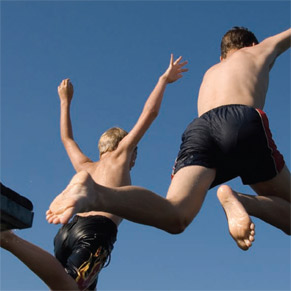
Most fatal drowning among teenagers takes place in lakes and rivers. Half of fatal incidents occur while the individual is swimming, but other aquatic activities such as powerboating, diving and jumping into water, and partying near or on the water are also common activities.
Diving into shallow water is a particularly high-risk activity, and its impact is only partially reflected in fatal drowning statistics. Some people who dive into shallow water suffer a broken neck or catastrophic spinal cord injury and, while they survive the incident, are paralyzed for life.
More than half of 13 to 17-year-olds involved in fatal drowning incidents are either alone or with other minors at the time of the incident. There are no adults present. Approximately 1 in 4 teenagers who die from drowning are non-swimmers or weak swimmers. Although still underage, alcohol and drugs are an added factor that increases drowning risk for 13 to 17-year-olds.
Drowning prevention tips
Learn to swim.
Knowing how to swim is a life skill. Sometimes, especially for families new to Canada, teenage children may not have had the chance to learn how to swim in their younger years. It is important for everyone to have basic swimming skills. Parents should help their teens to find swimming programs that help them feel comfortable and confident in the water.
In its Swim to Survive® Standard, the Lifesaving Society defines the minimum standard of swimming skill: roll into deep water, tread water for one minute, swim 50 metres. These are the essential minimum skills required to survive an unexpected fall into deep water.
Swim to Survive is only a first step to being safe around water. The Lifesaving Society's Swim and Lifesaving programs offer a wide range of aquatic training well beyond Swim to Survive.
Get the training.
If you have a pool, cottage or camp, ensure that family members learn lifesaving skills. Teens should enroll in lifesaving and lifeguarding courses such as the Bronze Medallion and National Lifeguard to obtain the skills for a lifetime of fun in the water and as preparation for a career as a lifeguard or swim instructor.
Protect your neck.
Spinal injuries are catastrophic, often rendering a teen paralyzed for life. Reduce the risk by checking water depth before jumping or diving in, entering unknown water feet first with a step- or slip-in entry, not diving in shallow lakes or pools, and by refraining from horseplay in a pool or waterfront area.
Wear your lifejacket; it won't work if you don't wear it.
Most people who die to drowning never intend to get in the water. Trying to put a lifejacket on just before you capsize is like trying to buckle a seat belt just before you have a car crash. Always wear your lifejacket while boating.
Always swim with a buddy.
Knowing how to swim is a great first step to staying safe while in, on and around the water. However, even good swimmers can get into trouble. Always swim and boat with a buddy so that there is someone who can call for help in an emergency. Learn lifesaving skills so you know self-rescue techniques and how to safely help others when they need you.